
Chris Waltham 2026
In the early 1960’s John Schelleng wrote a paper on violin physics that marked a major step in our understanding of how violins work. In it, he suggested some simple scaling rules that allow us to experiment with different materials and still produce an instrument that is recognisably a violin by its playability and sound.
In 2006 I made my first balsa violin, graduating the plates so they resonated close to “normal” frequencies. It enjoyed a decade of use as a demonstration instrument before succumbing to the tension of the strings. Balsa is not as robust as spruce and I should have stored the instrument detuned. In 2024 I made another, this time paying more attention to Schelleng’s belief that the back of the violin should have twice the impedance (resistance to vibrating motion) of the top (this is why violin tops are spruce and the backs are of denser maple). So, this time I used paulownia – with density intermediate between that of balsa and spruce – for the back. Paulownia is much used in Asian instruments like the ruan, but is not well known in the West. The balsa-paulownia violin is much lighter than a regular instrument, coming in at a touch less than 350 g (without the chin rest) in spite of the fact that the plates are – as Schelleng predicted – a little thicker than is normal. As before, my only concessions to the softness of balsa was to place a small piece of spruce veneer under the bridge, and not to attempt cutting channels for purfling. The result was a success, at least according to those who tried it out at our 2024 show and found it a lot of fun to play.
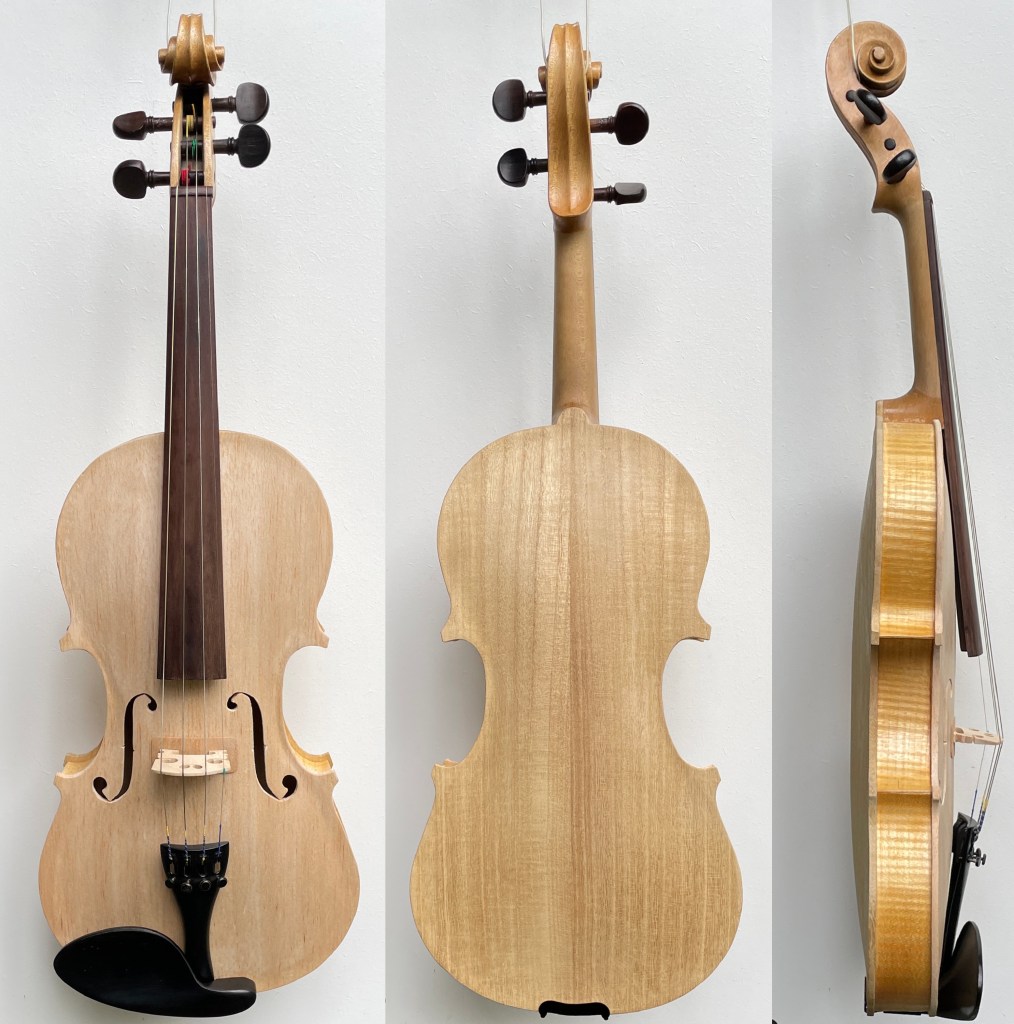
If you are interested in buying this instrument, or commissioning a similar one, please contact christopher.waltham@gmail.com

