
Chris Waltham
In 2006 I made a small 32-string harp, a copy of a late German example from around 1700, using engineering plans provided by the Boston Museum of Fine Arts. Like the original, the soundboard and back of the instrument were each carved out of one piece of maple, with the grain running in a longitudinal direction. Six small soundholes of elaborate design are cut into the soundboard. The string mounting is from the front, unlike most modern harps, and so does not require access through the soundholes. Brays were added after stringing. The overall height is 130 cm. The name “Gothic” refers to the pointed decoration on the neck. The instrument is relatively light for a harp (3.4 kg), and has good, attractive sound production, suitable for a small venue.
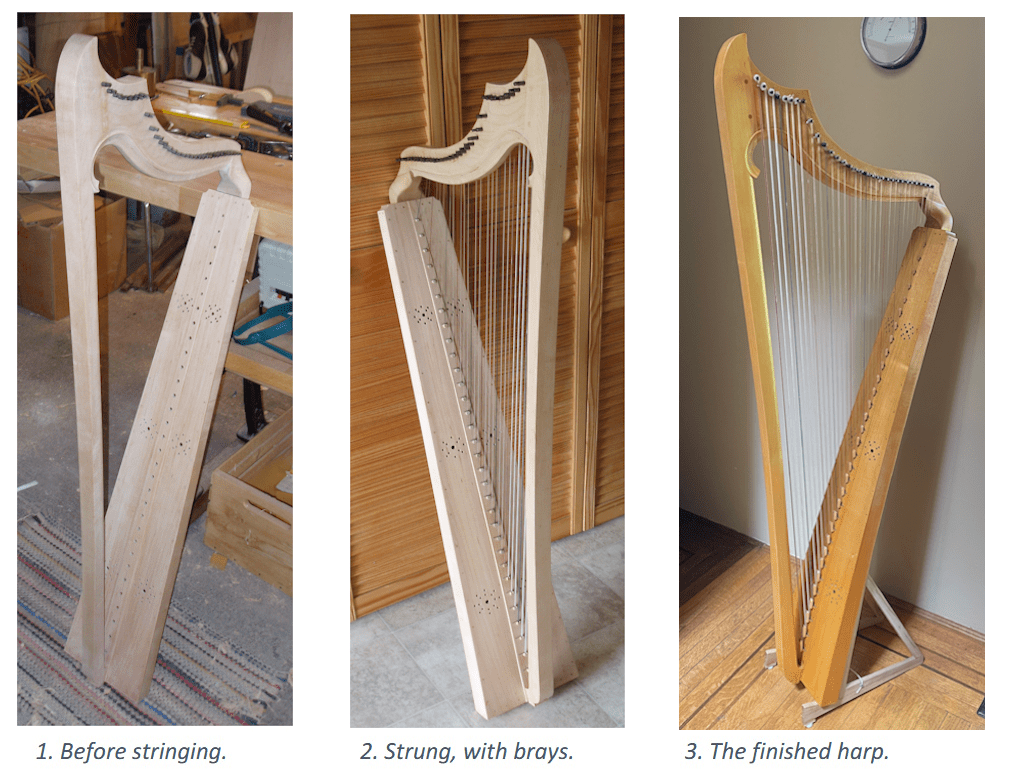
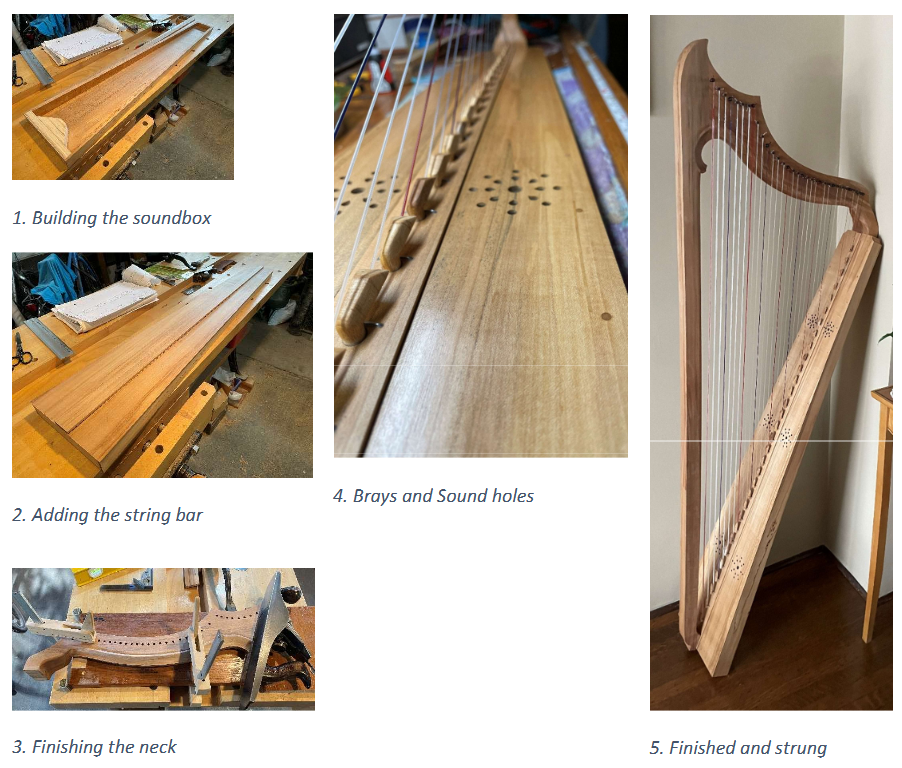
This Gothic Harp has somewhat narrow string spacing, which can be an issue for large hands. Thus, I decided to make a scaled-up version, when I could find pieces of maple big enough. The idea sat in my head for a couple of decades, then my neighbour Barry Narod mentioned that he had salvaged a Norway Maple log from a tree cut down on Manitoba Street (Vancouver BC) 20 years ago and it was begging to be made into something. The log was big enough for a harp 116% of the size of the original harp (overall height 150 cm). Over the course of summer (2024), we cut down the log at the Brock House woodshop and in Barry’s garage. Then we built the soundbox, neck and pillar, making extensive use of the shop’s planer, router and drum sander. The log was long enough for all parts except the pillar, which was formed from two pieces with a challenging joint (as was the German prototype). Almost everything came from the maple tree, except for the brays (sycamore, also locally sourced) and the only non-wooden parts are the iron pegs and nylons strings, both from North Shore Strings (Manchester NH).
The larger harp is somewhat easier to play than its smaller cousin, and also has a light, attractive sound.
If you are interested in buying one of these instruments, or commissioning a similar one, please contact christopher.waltham@gmail.com

